Zachary Charles's talking head b-roll ad is a 65-second tech & gadgets video creative decoded by Heista into 7 structural beats with 46 total cuts. Zachary Charles's full brand intelligence

Decode winning ads. Make them yours.
Generate script variations for your brand.
Or create a creator brief.
Script Builder requires an active PowerSource (website scan) to provide behavioral tensions and selling points.
Decode any video ad in seconds. See the psychology behind why it works.
Try HeistaZachary Charles's talking head b-roll ad is a 65-second tech & gadgets creative decoded by Heista into 7 structural beats. It opens with a Unexpected Fact Start hook — This leverages Contradiction Bias and Expectation Violation: the opening sets an expectation that the gadget enables “nine monitors,” but the “only two” Google result contradicts it on the spot. That contradiction triggers cognitive dissonance, making the viewer keep watching to resolve the mismatch between the claim and the evidence. The psychological mission is Curiosity Gap: The viewer is pulled forward by the mismatch between the claimed nine-monitor capability and the two-monitor limit, then feels the tension resolve as the step-by-step setup produces flickering confirmation that it actually works. The ad has 46 cuts at an average of 1.4s per cut, with an average beat duration of 9.3s.
Zachary Charles's talking head b-roll ad is a 65-second tech & gadgets video creative decoded by Heista into 7 structural beats with 46 total cuts. Zachary Charles's full brand intelligence
This leverages Contradiction Bias and Expectation Violation: the opening sets an expectation that the gadget enables “nine monitors,” but the “only two” Google result contradicts it on the spot. That contradiction triggers cognitive dissonance, making the viewer keep watching to resolve the mismatch between the claim and the evidence. Unexpected Fact Start hook deep-dive
Beat 2 (0:00-0:08) — Unexpected Fact Start: It starts with a counterintuitive claim about capability—“You can't plug nine monitors into your laptop unless you have this gadget”—then immediately undercuts it with a reality check: “But when I googled it, it said the max number of monitors you can use is only two.” This forces the viewer to mentally reconcile the “nine monitors” promise with the “only two” result, creating immediate tension about what’s true.
Beat 3 (0:08-0:18) — Inefficiency Pain: The speaker creates tension by highlighting wasted money and effort: “So I've gone ahead and bought six 27-inch 4k monitors.” The phrase “to see if it actually works” frames the purchase as an experiment driven by uncertainty, making the viewer feel the friction of trial-and-error spending.
Beat 4 (0:18-0:38) — Step-by-Step: It delivers a step-by-step setup sequence for connecting a docking station and multiple monitors: “First thing to do is to plug the docking station into power… then connect it… via USB-C… grab the first two monitors… via HDMI… Plug the third one in using DP-Link… fourth into your laptop’s HDMI… for the last two… use two USB ports.” It turns a potentially confusing multi-cable task into an ordered checklist the viewer can follow in real time.
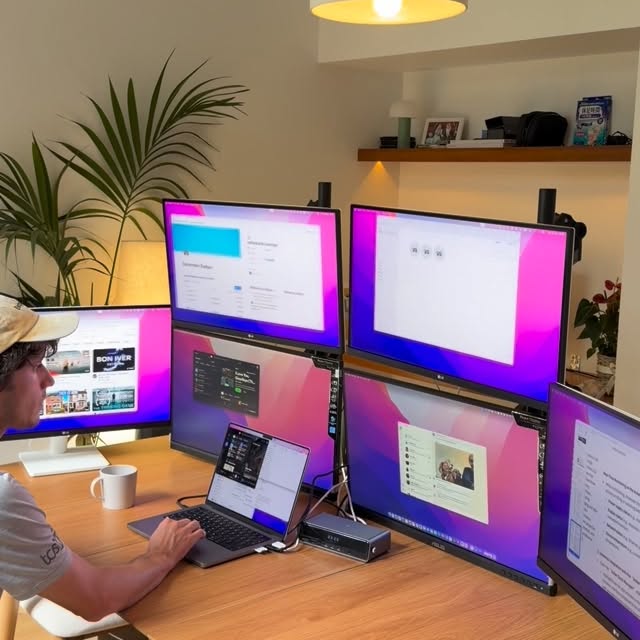
Beat 5 (0:38-0:50) — Micro Walkthrough: It gives a micro walkthrough of the setup workaround: “my table literally wasn't big enough,” so “I had to get these two dual vertical monitor mounts and set them up side by side,” then “attached four screens onto them.”
Beat 6 (0:50-0:58) — Live Result: The speaker runs a real-time validation test: “the last thing to do… was just to power on all the monitors. And one by one each of these screens flickered alive.” They then confirm the outcome immediately: “they actually work.”
Beat 7 (0:58-1:03) — The Easy Way: It reveals an easier expansion path: “Plus if you wanted a ninth screen you could connect your iPad via sidecar.” Instead of implying you’d need another dedicated setup, it offers a quick add-on method right there.
Beat 8 (1:03-1:04) — Redirect: It redirects viewers to an external resource: “It’s linked in my bio if you want to check it out.” This tells the viewer exactly where to go next (the bio link) rather than keeping them in the video.
This ad activates Curiosity Gap as its primary behavioral mission. The viewer is pulled forward by the mismatch between the claimed nine-monitor capability and the two-monitor limit, then feels the tension resolve as the step-by-step setup produces flickering confirmation that it actually works. Curiosity Gap behavioral mission
Duration: 65 seconds. Beat count: 7. Total cuts: 46. Average beat duration: 9.3s. Average cut duration: 1.4s. Average visual energy: 7.3/10.
Why does this Zachary Charles ad work? This Zachary Charles talking head b-roll ad opens with a Unexpected Fact Start hook that captures attention in the first 3 seconds. The psychological architecture activates Curiosity Gap across 7 structural beats, each contributing a specific persuasion mechanism.
What hook does Zachary Charles use in this ad? Zachary Charles opens with a Unexpected Fact Start hook. This leverages Contradiction Bias and Expectation Violation: the opening sets an expectation that the gadget enables “nine monitors,” but the “only two” Google result contradicts it on the spot. That contradiction triggers cognitive dissonance, making the viewer keep watching to resolve the mismatch between the claim and the evidence.
What psychology does this Zachary Charles ad activate? This ad activates Curiosity Gap as its primary behavioral mission. The viewer is pulled forward by the mismatch between the claimed nine-monitor capability and the two-monitor limit, then feels the tension resolve as the step-by-step setup produces flickering confirmation that it actually works.
How long is this Zachary Charles ad and what's the structure? This ad runs 65 seconds with 7 structural beats and 46 cuts. Average cut duration is 1.4s. The pattern flow follows a full format structure common in talking head b-roll ads.
What platform is this Zachary Charles ad running on? This talking head b-roll ad is running on instagram. The tech & gadgets vertical typically sees strong performance on this platform for talking head b-roll creative structures.
What makes this different from other tech & gadgets ads? Most tech & gadgets ads lean on generic format templates. Zachary Charles's version uses a distinct Unexpected Fact Start structure paired with Curiosity Gap — a combination that over-indexes in high-performing tech & gadgets creative.