Caraway's talking head b-roll ad is a 47-second home & living video creative decoded by Heista into 7 structural beats with 12 total cuts. Caraway's full brand intelligence
PATTERNMAP™
Loading PatternMap...
Ad Blueprint
Talking Head B-Roll
CategoryHome Living
AngleProblem Solution
NarrativeProduct First
IntentMicro Story Payoff Engine
Hook Type
Data Point Start
7.2sDuration
3Shots
4.3sAvg Shot
Energy
Cut Points
2.7s5.8s
Psychology
Competence Restoration
Behavioral ApproachPeer Recommend
Solution Assurance
Step Clarity
Knowledge Simplification
Every winning ad has a formula. Heista decodes it in seconds.
Caraway Ad Decoded — Data Point Start Hook Analysis (47s)
Caraway's talking head b-roll ad is a 47-second home & living creative decoded by Heista into 7 structural beats. It opens with a Data Point Start hook — This leverages Specificity Bias—“almost 300 grams” feels more credible and concrete than a vague claim, so the viewer’s brain treats it as evidence worth understanding. It also uses Quantifiable Credibility: the metric creates a verification target (“300 grams” becomes something to check), which increases attention and reduces the chance the viewer scrolls. Finally, the “every single day” repetition activates Commitment/Consistency heuristics, making the behaviour sound habitual rather than occasional, which raises perceived importance. The psychological mission is Competence Restoration: The viewer feels reassured that choosing non-toxic, easy-to-clean cookware will simplify meal prep, making the everyday routine feel manageable and worth sticking with. The ad has 12 cuts at an average of 3.8s per cut, with an average beat duration of 6.7s.
Key Takeaways
- Opens with a Data Point Start hook
- Activates Competence Restoration psychology
- Part of Caraway's full ad strategy
- 12 cuts, averaging 3.8s per cut
Overview
Data Point Start Hook
This leverages Specificity Bias—“almost 300 grams” feels more credible and concrete than a vague claim, so the viewer’s brain treats it as evidence worth understanding. It also uses Quantifiable Credibility: the metric creates a verification target (“300 grams” becomes something to check), which increases attention and reduces the chance the viewer scrolls. Finally, the “every single day” repetition activates Commitment/Consistency heuristics, making the behaviour sound habitual rather than occasional, which raises perceived importance. Data Point Start hook deep-dive
Beat-by-Beat Breakdown
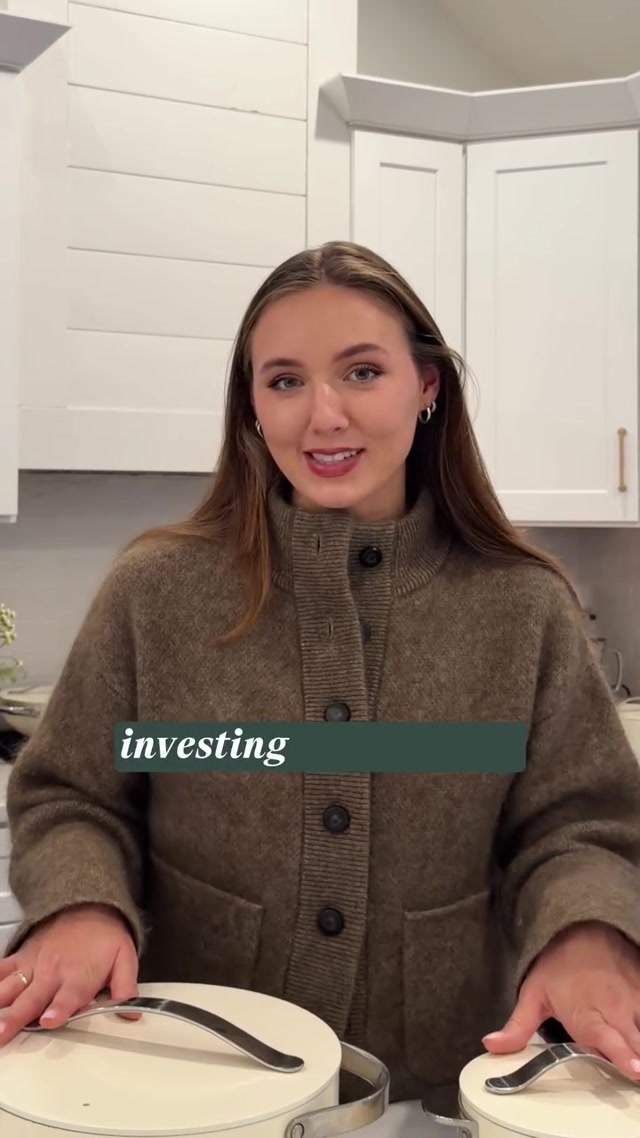
Beat 2 (0:00-0:07) — Data Point Start: It opens by stating a specific quantified claim: “we’re eating almost 300 grams of protein every single day.” That number is framed as a lived reality “Between me and my husband,” which anchors the rest of the video to an exact, measurable standard.
Beat 3 (0:07-0:18) — Topic Definition: It defines the content’s theme by linking two interests: “We love fitness… taking care of our bodies” and then reframing the next focus as “the quality of our cookware.” This tells the viewer the video is about extending food-quality care into cookware-quality choice.
Beat 4 (0:18-0:26) — Hidden Problem: It reframes the buyer’s cookware situation by calling out an unseen chemical hazard: “Our other cookware had microplastics, PFAs, forever chemical stuff that we don't want in our food.” This shifts the viewer’s focus from the visible “cookware” to the hidden risk that’s transferring into what they eat.
Beat 5 (0:26-0:34) — Feature Cascade: It stacks product claims and a decisive personal commitment: “made without any of that” (a specific differentiator), “we’ve switched most of our cookware to Caraway” (adoption signal), and “we won’t be going back” (finality). This creates value density in one tight stretch—anti-problem, proof of use, and no-return certainty all at once.
Beat 6 (0:34-0:41) — Before/After Proof: It reframes the product claim with a contrast: “we heard it was nonstick, but we didn’t think it was going to be this good” and then lands on the payoff “being able to just wipe these clean is top tier.” It uses the gap between expectation and lived result after a week of use to validate effectiveness.
Beat 7 (0:41-0:46) — You're Not Failing: It reframes hesitation into validated progress by expressing disbelief at how long they waited: “we’ve been using them for a couple months now” and “I cannot believe we waited this long.” This turns the implicit assumption that “we should’ve known earlier” into a normal, non-failure experience.
Beat 8 (0:46-0:47) — Redirect: It sends viewers to a specific sponsor/shop action: “You can check out Caraway to shop my favorite non-toxic cookware…”.
Behavioral Psychology
This ad activates Competence Restoration as its primary behavioral mission. The viewer feels reassured that choosing non-toxic, easy-to-clean cookware will simplify meal prep, making the everyday routine feel manageable and worth sticking with. Competence Restoration behavioral mission
Structural Fingerprint
Duration: 47 seconds. Beat count: 7. Total cuts: 12. Average beat duration: 6.7s. Average cut duration: 3.8s. Average visual energy: 4.3/10.
Frequently Asked Questions
Why does this Caraway ad work? This Caraway talking head b-roll ad opens with a Data Point Start hook that captures attention in the first 3 seconds. The psychological architecture activates Competence Restoration across 7 structural beats, each contributing a specific persuasion mechanism.
What hook does Caraway use in this ad? Caraway opens with a Data Point Start hook. This leverages Specificity Bias—“almost 300 grams” feels more credible and concrete than a vague claim, so the viewer’s brain treats it as evidence worth understanding. It also uses Quantifiable Credibility: the metric creates a verification target (“300 grams” becomes something to check), which increases attention and reduces the chance the viewer scrolls. Finally, the “every single day” repetition activates Commitment/Consistency heuristics, making the behaviour sound habitual rather than occasional, which raises perceived importance.
What psychology does this Caraway ad activate? This ad activates Competence Restoration as its primary behavioral mission. The viewer feels reassured that choosing non-toxic, easy-to-clean cookware will simplify meal prep, making the everyday routine feel manageable and worth sticking with.
How long is this Caraway ad and what's the structure? This ad runs 47 seconds with 7 structural beats and 12 cuts. Average cut duration is 3.8s. The pattern flow follows a full format structure common in talking head b-roll ads.
What platform is this Caraway ad running on? This talking head b-roll ad is running on facebook. The home & living vertical typically sees strong performance on this platform for talking head b-roll creative structures.
What makes this different from other home & living ads? Most home & living ads lean on generic format templates. Caraway's version uses a distinct Data Point Start hook structure paired with Competence Restoration — a combination that over-indexes in high-performing home & living creative.