Makeugc's talking head b-roll ad is a 58-second saas & software video creative decoded by Heista into 7 structural beats with 10 total cuts. Makeugc's full brand intelligence
PATTERNMAP™
Loading PatternMap...
Ad Blueprint
Talking Head B-Roll
CategorySaas Software
AngleHow To Tutorial
NarrativeProduct First
IntentNovelty Pattern Injection
Hook Type
Disruptive Statement
8.5sDuration
2Shots
7.3sAvg Shot
Energy
Cut Points
3.9s
Psychology
Loss Aversion
Behavioral ApproachDemonstrate Method
Negative Future Projection
Risk Priming
Avoidance Trigger
Fear Of Loss
Every winning ad has a formula. Heista decodes it in seconds.
Makeugc Ad Decoded — Disruptive Statement Hook Analysis (58s)
Makeugc's talking head b-roll ad is a 58-second saas & software creative decoded by Heista into 7 structural beats. It opens with a Disruptive Statement hook — This leverages Disruptive Statement by forcing cognitive dissonance—if the speaker “isn’t real,” the viewer expects obvious tells, so they keep watching to resolve the mismatch. It also creates an implicit Open Loop: the claim promises an explanation or proof of how it’s indistinguishable, pulling attention forward. The psychological mission is Loss Aversion: The viewer feels a sudden sense of danger and urgency, as if the situation is getting worse fast and they need to act before it’s too late. The ad has 10 cuts at an average of 6.4s per cut, with an average beat duration of 8.3s.
Key Takeaways
- Opens with a Disruptive Statement hook
- Activates Loss Aversion psychology
- Part of Makeugc's full ad strategy
- 10 cuts, averaging 6.4s per cut
Overview
Disruptive Statement Hook
This leverages Disruptive Statement by forcing cognitive dissonance—if the speaker “isn’t real,” the viewer expects obvious tells, so they keep watching to resolve the mismatch. It also creates an implicit Open Loop: the claim promises an explanation or proof of how it’s indistinguishable, pulling attention forward. Disruptive Statement hook deep-dive
Beat-by-Beat Breakdown
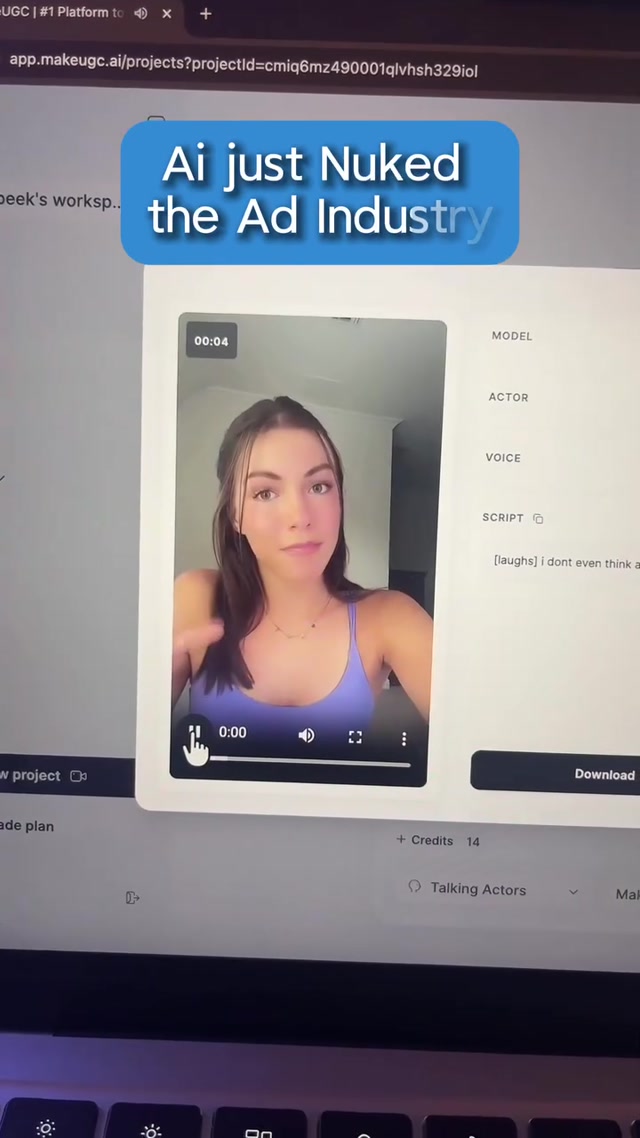
Beat 2 (0:00-0:08) — Disruptive Statement: It opens with a jarring, counterintuitive claim: “I don't even think anyone can tell that I'm not real.” This immediately breaks the viewer’s assumptions about what they’re watching and sets up a mystery about how “not real” can still pass as real.
Beat 3 (0:08-0:18) — Goal Context: It states the desired outcome up front: “you can fully change what they say, every emotion that they convey,” then escalates with “I’m gonna show you how to do it.” This turns the segment into a promise of controllable results, not just information, so the viewer immediately knows what they’ll be able to achieve.
Beat 4 (0:18-0:26) — Feature Breakdown: The speaker spotlights a single capability of the update: “lets you completely control the emotion of your avatars.” They frame it as a concrete, specific feature by pointing to what the new AI can do, then intensify it with “Holy shit.”
Beat 5 (0:26-0:33) — Fear → Relief: The speaker pivots from performative emotion (“I can say this and sound really angry… or… crying… or even laughing”) into a grim forecast: “I think we’re cooked.” This reframes the viewer’s emotional interpretation of the message—turning “how you say it” into a shared, high-stakes reality check in the same breath.
Beat 6 (0:33-0:46) — Micro Walkthrough: It gives a tight, step-by-step walkthrough for creating the UGC: “Head over to your MakeUGC account… click on the Talking Actors section… Then it’s as simple as using the AI scriptwriter or pasting in your normal script to add some emotion.” This turns the viewer from “learning” into “doing” by mapping the exact clicks and inputs they should make next.
Beat 7 (0:46-0:54) — Step-by-Step: It gives a mini step-by-step workflow: “select the character that you want to use for this script” and then “adjust the audio so that you like exactly how it sounds.” In this moment, it turns the viewer from passive watcher into an operator following precise actions in order.
Beat 8 (0:54-0:57) — Safety Assurance: The speaker validates the product by emphasizing it’s already “realistic” and then reduces friction to try it: “So if you want to test this product out for yourself… I’m gonna send you a link.” This frames the offer as low-risk and immediately actionable, so the viewer feels safe to take the next step.
Behavioral Psychology
This ad activates Loss Aversion as its primary behavioral mission. The viewer feels a sudden sense of danger and urgency, as if the situation is getting worse fast and they need to act before it’s too late. Loss Aversion behavioral mission
Structural Fingerprint
Duration: 58 seconds. Beat count: 7. Total cuts: 10. Average beat duration: 8.3s. Average cut duration: 6.4s. Average visual energy: 2.6/10.
Frequently Asked Questions
Why does this Makeugc ad work? This Makeugc talking head b-roll ad opens with a Disruptive Statement hook that captures attention in the first 3 seconds. The psychological architecture activates Loss Aversion across 7 structural beats, each contributing a specific persuasion mechanism.
What hook does Makeugc use in this ad? Makeugc opens with a Disruptive Statement hook. This leverages Disruptive Statement by forcing cognitive dissonance—if the speaker “isn’t real,” the viewer expects obvious tells, so they keep watching to resolve the mismatch. It also creates an implicit Open Loop: the claim promises an explanation or proof of how it’s indistinguishable, pulling attention forward.
What psychology does this Makeugc ad activate? This ad activates Loss Aversion as its primary behavioral mission. The viewer feels a sudden sense of danger and urgency, as if the situation is getting worse fast and they need to act before it’s too late.
How long is this Makeugc ad and what's the structure? This ad runs 58 seconds with 7 structural beats and 10 cuts. Average cut duration is 6.4s. The pattern flow follows a full format structure common in talking head b-roll ads.
What platform is this Makeugc ad running on? This talking head b-roll ad is running on facebook. The saas & software vertical typically sees strong performance on this platform for talking head b-roll creative structures.
What makes this different from other saas & software ads? Most saas & software ads lean on generic format templates. Makeugc's version uses a distinct Disruptive Statement hook structure paired with Loss Aversion — a combination that over-indexes in high-performing saas & software creative.