LAB Golf's talking head b-roll ad is a 30-second sports outdoors video creative decoded by Heista into 6 structural beats with 15 total cuts. LAB Golf's full brand intelligence
PATTERNMAP™
Loading PatternMap...
Ad Blueprint
Talking Head B-Roll
CategorySports Outdoors
AngleProblem Solution
NarrativeProduct First
IntentMechanism Reveal
Hook Type
Open Loop Statement
3.8sDuration
3Shots
1.7sAvg Shot
Energy
Cut Points
1.5s3.5s
Psychology
Threat Reduction
Behavioral ApproachBuild Authority
Uncertainty Resolution
Reassurance Statement
Fear Cancellation
Soothing Tone
Every winning ad has a formula. Heista decodes it in seconds.
LAB Golf Ad Decoded — Open Loop Statement Hook Analysis (30s)
LAB Golf's talking head b-roll ad is a 30-second sports outdoors creative decoded by Heista into 6 structural beats. It opens with a Open Loop Statement hook — This leverages the Open Loop Statement principle: the sentence implies an incoming moment (“bringing the blade back”) but withholds the critical payoff, creating a mental to-do item. That open loop drives sustained attention through Completion Tension—viewers can’t “finish” the mental storyline until the next beat clarifies the outcome. The psychological mission is Threat Reduction: The viewer feels reassured that design challenges were overcome and that the blade will be stable in motion, reducing doubt about performance and balance. The ad has 15 cuts at an average of 2.3s per cut, with an average beat duration of 5s.
Key Takeaways
- Opens with a Open Loop Statement hook
- Activates Threat Reduction psychology
- Part of LAB Golf's full ad strategy
- 15 cuts, averaging 2.3s per cut
Overview
Open Loop Statement Hook
This leverages the Open Loop Statement principle: the sentence implies an incoming moment (“bringing the blade back”) but withholds the critical payoff, creating a mental to-do item. That open loop drives sustained attention through Completion Tension—viewers can’t “finish” the mental storyline until the next beat clarifies the outcome. Open Loop Statement hook deep-dive
Beat-by-Beat Breakdown
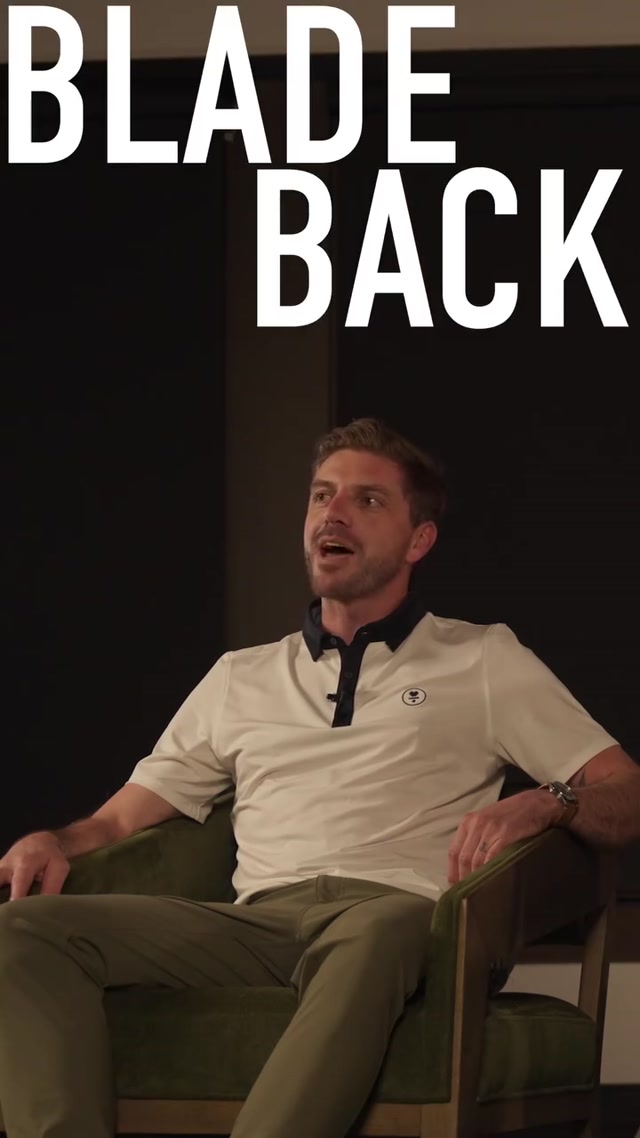
Beat 2 (0:00-0:03) — Open Loop Statement: It creates a suspenseful action-in-progress statement: “we’re bringing the blade back.” The phrasing with no explanation leaves an unresolved question—what blade, and what happens when it comes back—so the viewer’s brain flags the gap and waits for the missing context.
Beat 3 (0:03-0:13) — Process Setup: It outlines the workflow decisions in the design process: starting “with adding some style and flair,” then adding “alignment features,” then switching to a specific physical step (“we placed all our weights on the sole”) to achieve a visual outcome (“To ensure a clean top line”). In this moment, it turns the viewer’s attention from the end result to the concrete method being used.
Beat 4 (0:13-0:18) — Inefficiency Pain: It points to a specific source of ongoing performance trouble: “This, plus moving the shaft to the heel, presented a lot of challenges for balancing.” The beat makes the viewer mentally label the action change as creating extra work—more difficulty “for balancing” than expected.
Beat 5 (0:18-0:23) — Story Continuation: It references earlier progress and credits the prior reference point: “we conquered these challenges” by “everything we learned from the Link One.” This continues an ongoing narrative of overcoming obstacles and ties the win directly to a specific earlier source (“Link One”).
Beat 6 (0:23-0:27) — Expertise Claim: The speaker asserts a confident, specialty-level judgment: “this is the most stable blade in motion.”
Beat 7 (0:27-0:30) — Hidden Truth: It reveals the intended engineering trade-off behind the design update: “With the Link 2.1 and 2.2, the goal was to bring back the blade with the traditional look and the unmatched performance…” This reframes the upgrades from being just new versions into a deliberate choice to restore a specific look while preserving a performance advantage, which sets the stage for the viewer to treat the product changes as purposeful rather than cosmetic.
Behavioral Psychology
This ad activates Threat Reduction as its primary behavioral mission. The viewer feels reassured that design challenges were overcome and that the blade will be stable in motion, reducing doubt about performance and balance. Threat Reduction behavioral mission
Structural Fingerprint
Duration: 30 seconds. Beat count: 6. Total cuts: 15. Average beat duration: 5s. Average cut duration: 2.3s. Average visual energy: 6.3/10.
Frequently Asked Questions
Why does this LAB Golf ad work? This LAB Golf talking head b-roll ad opens with a Open Loop Statement hook that captures attention in the first 3 seconds. The psychological architecture activates Threat Reduction across 6 structural beats, each contributing a specific persuasion mechanism.
What hook does LAB Golf use in this ad? LAB Golf opens with a Open Loop Statement hook. This leverages the Open Loop Statement principle: the sentence implies an incoming moment (“bringing the blade back”) but withholds the critical payoff, creating a mental to-do item. That open loop drives sustained attention through Completion Tension—viewers can’t “finish” the mental storyline until the next beat clarifies the outcome.
What psychology does this LAB Golf ad activate? This ad activates Threat Reduction as its primary behavioral mission. The viewer feels reassured that design challenges were overcome and that the blade will be stable in motion, reducing doubt about performance and balance.
How long is this LAB Golf ad and what's the structure? This ad runs 30 seconds with 6 structural beats and 15 cuts. Average cut duration is 2.3s. The pattern flow follows a full format structure common in talking head b-roll ads.
What platform is this LAB Golf ad running on? This talking head b-roll ad is running on facebook. The sports outdoors vertical typically sees strong performance on this platform for talking head b-roll creative structures.
What makes this different from other sports outdoors ads? Most sports outdoors ads lean on generic format templates. LAB Golf's version uses a distinct Open Loop Statement hook structure paired with Threat Reduction — a combination that over-indexes in high-performing sports outdoors creative.