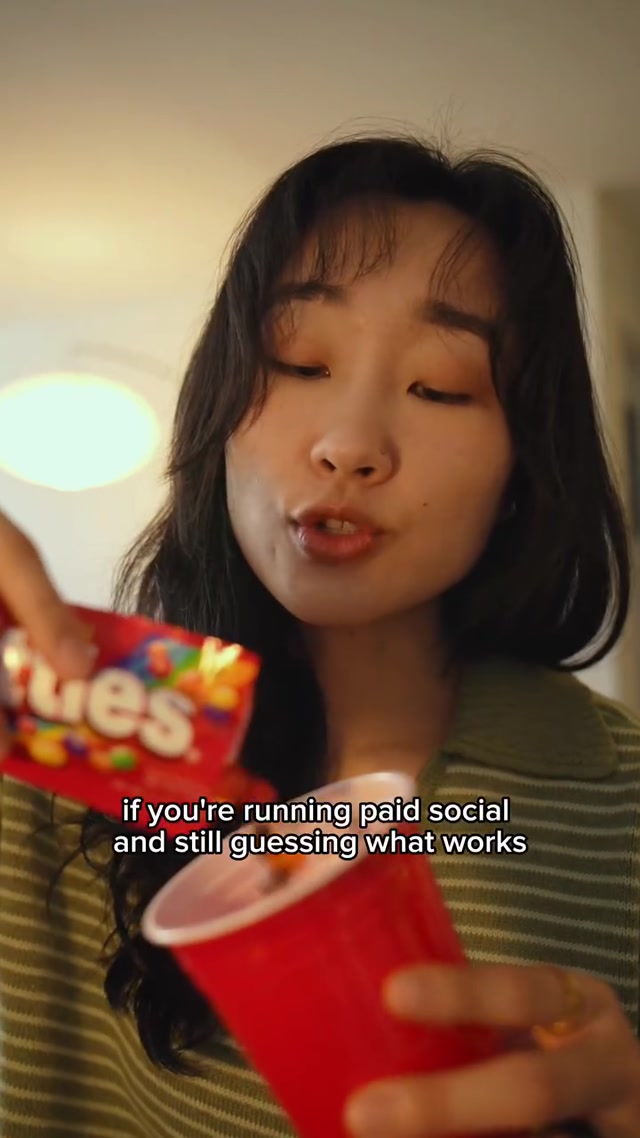
Joey Mulcahy's talking head screen ad is a 27-second saas & software video creative decoded by Heista into 5 structural beats with 13 total cuts. Joey Mulcahy's full brand intelligence
PATTERNMAP™
Loading PatternMap...
Ad Blueprint
Talking Head Screen
CategorySaas Software
AngleHow To Tutorial
NarrativeReels Soft CTA
IntentComment Bait Interaction Driver
Hook Type
Data Point Start
4.2sDuration
5Shots
1.5sAvg Shot
Energy
Cut Points
1.0s2.2s2.9s4.1s
Psychology
Loss Aversion
Behavioral ApproachDemonstrate Method
Negative Future Projection
Risk Priming
Avoidance Trigger
Fear Of Loss
Scarcity Cue
Every winning ad has a formula. Heista decodes it in seconds.
Joey Mulcahy Ad Decoded — Data Point Start Hook Analysis (27s)
Joey Mulcahy's talking head screen ad is a 27-second saas & software creative decoded by Heista into 5 structural beats. It opens with a Data Point Start hook — This leverages Data Point Start—numbers like “100 ads” act as a high-salience anchor that feels concrete and worth verifying, activating the need to understand the mechanism. The “one prompt” constraint increases the perceived impossibility, creating a Curiosity Spike around the missing process; viewers stay to resolve the information gap of how such output could come from such little input. The psychological mission is Loss Aversion: The viewer feels urgency to avoid falling behind because they see a fast way to replicate winning ads and even clone competitors, making inaction feel costly. The ad has 13 cuts at an average of 2.3s per cut, with an average beat duration of 5.4s.
Key Takeaways
- Opens with a Data Point Start hook
- Activates Loss Aversion psychology
- Part of Joey Mulcahy's full ad strategy
- 13 cuts, averaging 2.3s per cut
Overview
Data Point Start Hook
This leverages Data Point Start—numbers like “100 ads” act as a high-salience anchor that feels concrete and worth verifying, activating the need to understand the mechanism. The “one prompt” constraint increases the perceived impossibility, creating a Curiosity Spike around the missing process; viewers stay to resolve the information gap of how such output could come from such little input. Data Point Start hook deep-dive
Beat-by-Beat Breakdown
Beat 2 (0:00-0:04) — Data Point Start: It opens with a quantified result: “100 ads” tied to a specific input-output claim (“with one prompt”). This immediate metric-to-method framing creates a “how did that happen?” gap before the viewer even knows the steps.
Beat 3 (0:04-0:11) — Process Setup: It lays out the exact workflow the viewer should follow: “Just drop in an example of an ad you want to recreate” and then Claude “will break it down into JSON format,” “scrape your product's landing page,” and “write you new headlines with on-brand icons, colors and everything.” This frames the rest of the video as a step-by-step procedure that turns inputs into specific outputs.
Beat 4 (0:11-0:18) — Micro Walkthrough: It gives a tight process walkthrough of the image-generation pipeline: “Claude adds this to the JSON prompt,” then “goes to Nano Banana 2 to generate the image,” immediately correcting the mental model with “But that's not it.”
Beat 5 (0:18-0:23) — The Easy Way: The beat reveals “the easy way” to outcompete a competitor: it reframes ad research from a manual grind into a scalable clone process by saying, “you could recreate 10 or 100 ads at a time to clone a competitor's entire ad library.” In this moment, it signals a shortcut that turns a complex task into a single repeatable workflow.
Beat 6 (0:23-0:26) — Message Me: It directly asks viewers to take a DM-style action: “drop ads in the comments and I’ll send you the full guide.” This pairs a simple prompt with an immediate fulfillment promise (the full guide).
Behavioral Psychology
This ad activates Loss Aversion as its primary behavioral mission. The viewer feels urgency to avoid falling behind because they see a fast way to replicate winning ads and even clone competitors, making inaction feel costly. Loss Aversion behavioral mission
Structural Fingerprint
Duration: 27 seconds. Beat count: 5. Total cuts: 13. Average beat duration: 5.4s. Average cut duration: 2.3s. Average visual energy: 6.4/10.
Frequently Asked Questions
Why does this Joey Mulcahy ad work? This Joey Mulcahy talking head screen ad opens with a Data Point Start hook that captures attention in the first 3 seconds. The psychological architecture activates Loss Aversion across 5 structural beats, each contributing a specific persuasion mechanism.
What hook does Joey Mulcahy use in this ad? Joey Mulcahy opens with a Data Point Start hook. This leverages Data Point Start—numbers like “100 ads” act as a high-salience anchor that feels concrete and worth verifying, activating the need to understand the mechanism. The “one prompt” constraint increases the perceived impossibility, creating a Curiosity Spike around the missing process; viewers stay to resolve the information gap of how such output could come from such little input.
What psychology does this Joey Mulcahy ad activate? This ad activates Loss Aversion as its primary behavioral mission. The viewer feels urgency to avoid falling behind because they see a fast way to replicate winning ads and even clone competitors, making inaction feel costly.
How long is this Joey Mulcahy ad and what's the structure? This ad runs 27 seconds with 5 structural beats and 13 cuts. Average cut duration is 2.3s. The pattern flow follows a compressed format structure common in talking head screen ads.
What platform is this Joey Mulcahy ad running on? This talking head screen ad is running on instagram. The saas & software vertical typically sees strong performance on this platform for talking head screen creative structures.
What makes this different from other saas & software ads? Most saas & software ads lean on generic format templates. Joey Mulcahy's version uses a distinct Data Point Start hook structure paired with Loss Aversion — a combination that over-indexes in high-performing saas & software creative.