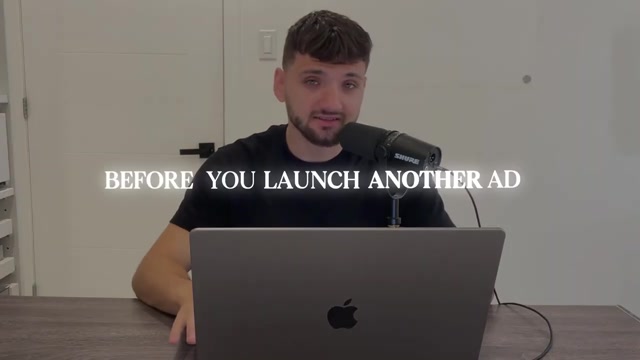
Adrian Chivu's talking head screen ad is a 928-second saas & software video creative decoded by Heista into 9 structural beats with 44 total cuts. Adrian Chivu's full brand intelligence
PATTERNMAP™
Loading PatternMap...
Ad Blueprint
Talking Head Screen
CategorySaas Software
AngleHow To Tutorial
NarrativeExpert Frame
IntentValue Stack Acceleration
Hook Type
Diagnostic Question
18.5sDuration
10Shots
2.1sAvg Shot
Energy
Cut Points
1.3s2.3s5.6s6.3s7.8s8.3s10.5s12.0s14.9s
Psychology
Status Assertion
Behavioral ApproachTeach Explain
Authority Claim
Competence Display
Proof Credential
Dominant Posture Language
Every winning ad has a formula. Heista decodes it in seconds.
Adrian Chivu Ad Decoded — Diagnostic Question Hook Analysis (928s)
Adrian Chivu's talking head screen ad is a 928-second saas & software creative decoded by Heista into 9 structural beats. It opens with a Diagnostic Question hook — This leverages Diagnostic Question and Loss Aversion. The diagnostic question triggers self-assessment—viewers mentally check whether they “actually know,” creating immediate internal tension. The “costing you real money” line activates Loss Aversion, making the risk feel concrete, so they keep watching to resolve the uncertainty and avoid wasting spend. The psychological mission is Status Assertion: The viewer feels reassured that the process is credible and professionally guided, reducing doubt and making the recommended KPIs and testing approach feel safe to follow. The ad has 44 cuts at an average of 57.2s per cut, with an average beat duration of 103.2s.
Key Takeaways
- Opens with a Diagnostic Question hook
- Activates Status Assertion psychology
- Part of Adrian Chivu's full ad strategy
- 44 cuts, averaging 57.2s per cut
Overview
Diagnostic Question Hook
This leverages Diagnostic Question and Loss Aversion. The diagnostic question triggers self-assessment—viewers mentally check whether they “actually know,” creating immediate internal tension. The “costing you real money” line activates Loss Aversion, making the risk feel concrete, so they keep watching to resolve the uncertainty and avoid wasting spend. Diagnostic Question hook deep-dive
Beat-by-Beat Breakdown
Beat 2 (0:00-0:18) — Diagnostic Question: It opens with a diagnostic question: “Before you launch another ad, answer this, do you actually know why your last ad performed?” Then it escalates the stakes with a direct consequence statement: “If the answer is no, you are guessing and it's costing you real money.” This forces the viewer to self-audit immediately rather than passively watch.
Beat 3 (0:18-0:55) — Authority Setup: The speaker establishes credibility by tying the topic to their real-world scale and role: “I’m Adrian, co-founder and CMO of The Social Ad, an e-commerce growth partner spending millions across Meta and Google.” This frames the upcoming data breakdown as something learned from high-budget execution, not theory.
Beat 4 (0:55-2:50) — Mental Model Explanation: It reframes how to interpret marketing data by contrasting two mindsets: “Most people treat data like a scorecard; I treat it like a diagnostic tool.” Then it defines the diagnostic mental model with specific diagnostic questions: “what creative pulls people in, where the funnel drops, and what test created lift.”
Beat 5 (2:50-6:00) — Checklist Delivery: It delivers a KPI checklist with explicit benchmark targets: “Top-of-funnel metrics: attention, hold, and click desire,” then “Video hook rate benchmarks (25–30%… above 30–35%… 57% unicorn),” “Follow hook with hold rate; aim for at least 15% moving past 3 seconds,” “Watch time benchmarks (4–6 seconds… 11 seconds very solid),” and “Link click-through/outbound CTR: aim above 1%.” This turns abstract performance advice into a concrete scorecard the viewer can mentally verify against their own numbers.
Beat 6 (6:00-7:50) — Metric Proof: It validates the method with concrete ad-performance metrics: “54% hook rate,” “~10 seconds watch time,” and “~0.98% outbound CTR.” It then frames the results as “hitting the marks and ready to scale,” tying the numbers to a performance outcome.
Beat 7 (7:50-10:50) — Feature Cascade: It rapidly lists the exact funnel checkpoints and ratios to diagnose where users drop off: “click-to-add-to-cart, add-to-initiate-checkout, and initiate-checkout-to-purchase ratios,” then adds “conversion rate (purchases/outbound clicks)” and “review multiple time windows (7/14/30 days).” It also stacks benchmark thresholds—“15–20%… otherwise messaging problem,” “~50%… to checkout,” and “25–30%… to purchase”—so the viewer has a dense set of targets to compare against.
Beat 8 (10:50-13:40) — Hidden Problem: It reframes “creative fatigue and performance drops” as not random, but caused by specific hidden drivers: “changes in the account or outside it (audience, angles, offers, funnel conversion).” Then it narrows the diagnosis by pointing to what the data shows didn’t work: “offer, early attention, desire/angle, or the problem the ad solves.”
Beat 9 (13:40-15:10) — Checklist Delivery: It delivers a “Three mistakes to avoid” checklist, then itemizes each fix: (1) “obsessing over ROAS without attribution clarity” with “set attribution windows and break down click vs view” and “set targets per product using unit economics,” (2) “Don’t mix retargeting with prospecting” with “keep them separate and use different messaging,” and (3) “Don’t stack variables in testing” by “isolate offers, formats, angles, and landing pages.” This turns the advice into a scannable set of do-not-errors the viewer can audit against immediately.
Beat 10 (15:10-15:28) — Direct CTA: The creator ends with a direct action stack: “like, subscribe, and I’ll see you in the next one.” This explicitly tells viewers to perform two platform actions (like + subscribe) and then stay for the next video.
Behavioral Psychology
This ad activates Status Assertion as its primary behavioral mission. The viewer feels reassured that the process is credible and professionally guided, reducing doubt and making the recommended KPIs and testing approach feel safe to follow. Status Assertion behavioral mission
Structural Fingerprint
Duration: 928 seconds. Beat count: 9. Total cuts: 44. Average beat duration: 103.2s. Average cut duration: 57.2s. Average visual energy: 1.9/10.
Frequently Asked Questions
Why does this Adrian Chivu ad work? This Adrian Chivu talking head screen ad opens with a Diagnostic Question hook that captures attention in the first 3 seconds. The psychological architecture activates Status Assertion across 9 structural beats, each contributing a specific persuasion mechanism.
What hook does Adrian Chivu use in this ad? Adrian Chivu opens with a Diagnostic Question hook. This leverages Diagnostic Question and Loss Aversion. The diagnostic question triggers self-assessment—viewers mentally check whether they “actually know,” creating immediate internal tension. The “costing you real money” line activates Loss Aversion, making the risk feel concrete, so they keep watching to resolve the uncertainty and avoid wasting spend.
What psychology does this Adrian Chivu ad activate? This ad activates Status Assertion as its primary behavioral mission. The viewer feels reassured that the process is credible and professionally guided, reducing doubt and making the recommended KPIs and testing approach feel safe to follow.
How long is this Adrian Chivu ad and what's the structure? This ad runs 928 seconds with 9 structural beats and 44 cuts. Average cut duration is 57.2s. The pattern flow follows a full format structure common in talking head screen ads.
What platform is this Adrian Chivu ad running on? This talking head screen ad is running on facebook. The saas & software vertical typically sees strong performance on this platform for talking head screen creative structures.
What makes this different from other saas & software ads? Most saas & software ads lean on generic format templates. Adrian Chivu's version uses a distinct Diagnostic Question hook structure paired with Status Assertion — a combination that over-indexes in high-performing saas & software creative.