ClickUp's interview podcast ad is a 42-second saas & software video creative decoded by Heista into 7 structural beats with 13 total cuts. ClickUp's full brand intelligence
PATTERNMAP™
Loading PatternMap...
Ad Blueprint
Interview Podcast
CategorySaas Software
AngleProduct Launch
NarrativeBenefit First
IntentValue Stack Acceleration
Hook Type
Direct Question Hook
6.2sDuration
4Shots
2.0sAvg Shot
Energy
Cut Points
3.1s4.2s6.1s
Psychology
Competence Restoration
Behavioral ApproachDemand Generation Prime
Solution Assurance
Step Clarity
Competence Reframing
Knowledge Simplification
Every winning ad has a formula. Heista decodes it in seconds.
ClickUp Ad Decoded — Direct Question Hook Analysis (42s)
ClickUp's interview podcast ad is a 42-second saas & software creative decoded by Heista into 7 structural beats. It opens with a Direct Question hook — This leverages Direct Question Hook and Curiosity Spike: the question is answerable, but the “all-in-one” promise creates an information gap that demands resolution. The stacked specifics (“all my tasks… all in one place… store my docs… my client’s stuff”) trigger Curiosity Spike by making the viewer wait to see whether the system can truly cover everything without breaking. The psychological mission is Competence Restoration: The viewer feels their chaos is solvable and their workflow becomes simpler and more reliable, restoring confidence that they can stay on top of tasks without juggling tools. The ad has 13 cuts at an average of 3.8s per cut, with an average beat duration of 6s.
Key Takeaways
- Opens with a Direct Question hook
- Activates Competence Restoration psychology
- Part of ClickUp's full ad strategy
- 13 cuts, averaging 3.8s per cut
Overview
Direct Question Hook
This leverages Direct Question Hook and Curiosity Spike: the question is answerable, but the “all-in-one” promise creates an information gap that demands resolution. The stacked specifics (“all my tasks… all in one place… store my docs… my client’s stuff”) trigger Curiosity Spike by making the viewer wait to see whether the system can truly cover everything without breaking. Direct Question hook deep-dive
Beat-by-Beat Breakdown
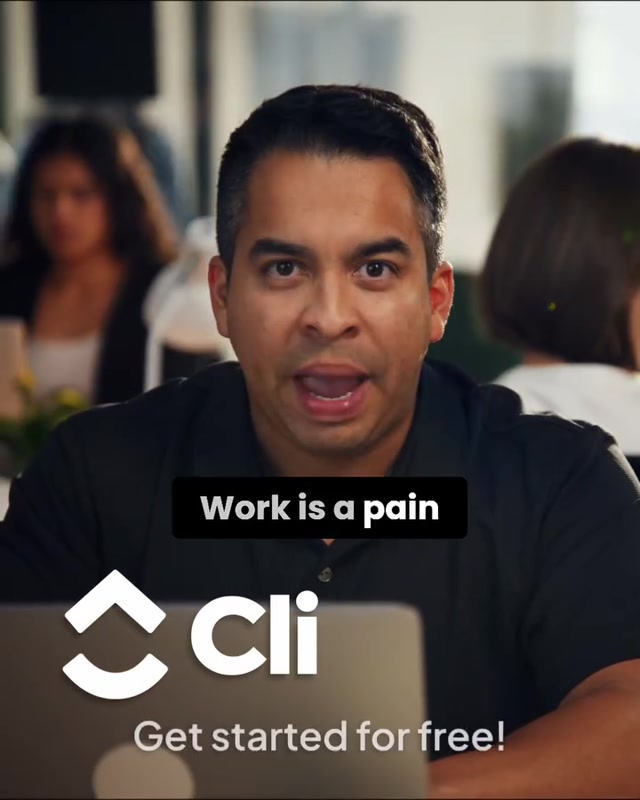
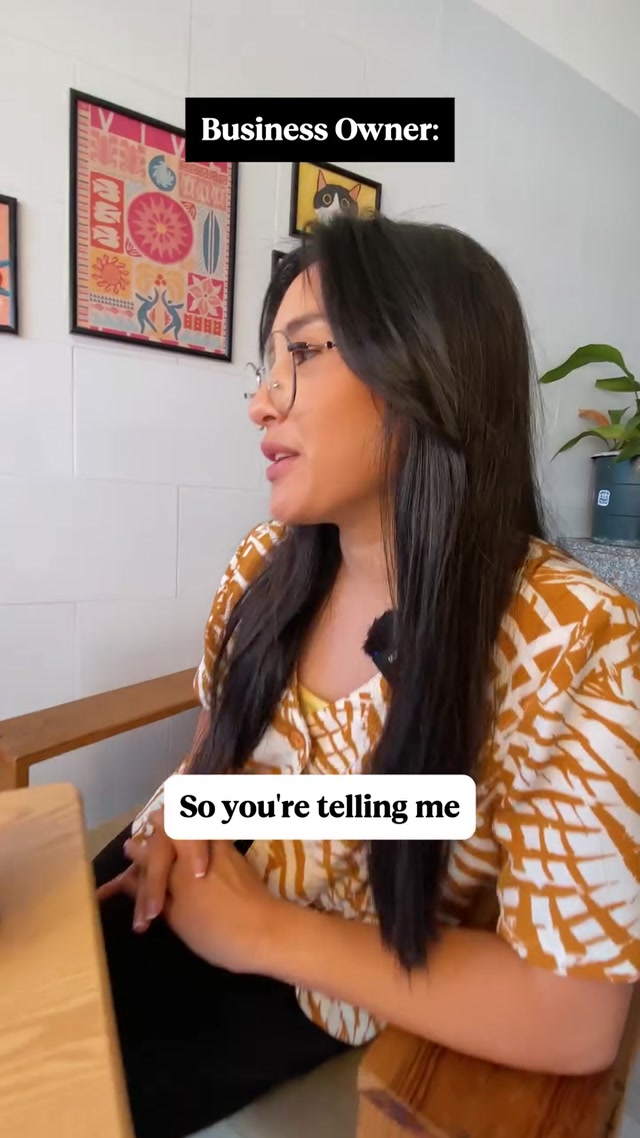
Beat 2 (0:00-0:06) — Direct Question Hook: It opens with a direct challenge question: “So you’re telling me you can manage all my tasks and talk to my team all in one place…?” The viewer is immediately put in a “prove it” mindset, with the speaker stacking claims (“manage all my tasks,” “talk to my team,” “store my docs, my ideas, and my client’s stuff”) to set up a justification to come.
Beat 3 (0:06-0:14) — Function Demonstration: It demonstrates the product’s workflow in plain cause-and-effect: “do you also record meetings? Not only that, I transcribe them and turn them into tasks so you don't forget what was said 5 seconds later.” The beat turns the abstract feature set into a concrete sequence the viewer can mentally simulate immediately.
Beat 4 (0:14-0:20) — Surface Problem: The speaker dismisses the “AI?” doubt by reframing it as an upgrade: “Ok, ok, but AI? I got a whole AI brain assistant.” This creates tension by directly addressing the viewer’s skepticism and replacing it with a bigger, more capable alternative.
Beat 5 (0:20-0:30) — Misconception Correction: The speaker corrects the viewer’s implied assumption that they need “5 different apps” by reframing the system as one connected workflow: “I connect your tasks, docs, goals… automate your tasks.” Then they land the correction with a direct question: “So basically I don't need 5 different apps?”
Beat 6 (0:30-0:34) — Expertise Claim: The speaker dismisses alternatives and asserts sole authority with the line “Nope, just me.” This positions the creator as the only credible source, cutting off the need for external validation.
Beat 7 (0:34-0:39) — You're Not Alone: The speaker asks a direct empathy question—“Where were you when I was losing my mind last month?”—then answers it with a shared-location claim: “Right here.” This reframes the moment of stress as something the viewer is already part of, not something they’re uniquely experiencing.
Beat 8 (0:39-0:41) — Retention Hook: The closing beat uses a Retention Hook—ending on a twist/insight that makes the viewer want to rewatch rather than simply stop. Because the transcript slice is only “(Closing beat)”, the only actionable classification signal is that this is a late-stage retention-oriented close.
Behavioral Psychology
This ad activates Competence Restoration as its primary behavioral mission. The viewer feels their chaos is solvable and their workflow becomes simpler and more reliable, restoring confidence that they can stay on top of tasks without juggling tools. Competence Restoration behavioral mission
Structural Fingerprint
Duration: 42 seconds. Beat count: 7. Total cuts: 13. Average beat duration: 6s. Average cut duration: 3.8s. Average visual energy: 4/10.
Frequently Asked Questions
Why does this ClickUp ad work? This ClickUp interview podcast ad opens with a Direct Question hook that captures attention in the first 3 seconds. The psychological architecture activates Competence Restoration across 7 structural beats, each contributing a specific persuasion mechanism.
What hook does ClickUp use in this ad? ClickUp opens with a Direct Question hook. This leverages Direct Question Hook and Curiosity Spike: the question is answerable, but the “all-in-one” promise creates an information gap that demands resolution. The stacked specifics (“all my tasks… all in one place… store my docs… my client’s stuff”) trigger Curiosity Spike by making the viewer wait to see whether the system can truly cover everything without breaking.
What psychology does this ClickUp ad activate? This ad activates Competence Restoration as its primary behavioral mission. The viewer feels their chaos is solvable and their workflow becomes simpler and more reliable, restoring confidence that they can stay on top of tasks without juggling tools.
How long is this ClickUp ad and what's the structure? This ad runs 42 seconds with 7 structural beats and 13 cuts. Average cut duration is 3.8s. The pattern flow follows a full format structure common in interview podcast ads.
What platform is this ClickUp ad running on? This interview podcast ad is running on facebook. The saas & software vertical typically sees strong performance on this platform for interview podcast creative structures.
What makes this different from other saas & software ads? Most saas & software ads lean on generic format templates. ClickUp's version uses a distinct Direct Question hook structure paired with Competence Restoration — a combination that over-indexes in high-performing saas & software creative.